


植物雄性不育是利用杂种活力或杂种优势的关键育种工具。杂种优势是指两个亲本杂交后代在生长势、丰产性、抗逆性等方面优于双亲的现象,据Tester和Langridge[5]报道杂交种产量比自交系高15%~50%。杂种优势的利用在全球农作物生产中取得了巨大的经济效益,其中玉米、水稻、高粱、油菜和向日葵等主要农作物超过一半的产量来自杂交品种 [6]。因此,杂交种的选育在很大程度上有益于世界粮食供给,但是杂种优势的发挥由于制种的纯度不高而受到影响[7,8]。利用常规的制种方法配制杂交种需要对母本进行人工去雄,不仅耗费大量的劳动力,还增加种子生产成本。利用雄性不育制种, 首先可以避免人工去雄所消耗的人力物力,另外不育化制种还可提高种子纯度, 从而持续地保持作物的杂种优势。因此,科学家们一直在研究雄性不育的遗传资源、分子机制及其在杂种优势中的应用。
玉米等雌雄异花作物杂交种的生产通常是将父母本自交系间隔种植,在保证父本的花粉授予母本的同时要防止母本被授予自身花粉,这样才能保证高纯度杂交种的生产。至今已经发展了一些方法可以在生产过程中阻止母本自花授粉。玉米杂交种生产是在母本花粉成熟前去雄,其中人工去雄需花费大量的人力物力,而机械去雄则会给母本植株带来机械伤害从而减少制种产量[9]。对于水稻、小麦和高粱等雌雄同花的植物,一般使用化学杀雄的方法,但是该方法存在污染环境、高成本、低产量等缺点[10]。近年来,随着基因工程的发展,研究人员开发了以生物技术为基础的方法来实现雄性不育,这些方法大多涉及转基因技术,因此未能得到广泛的商业利用。目前应用较广泛的是基于细胞质不育的三系配套系统,环境敏感型核不育的二系系统,以及利用单个核不育基因的智能不育技术。本文将分析作物雄性不育的不同途径,并总结各途径的研究进展及其在作物杂种优势中的应用。
1 细胞质雄性不育及其应用
植物细胞质雄性不育由于在细胞器基因组(线粒体)和核基因组间无法建立和谐联系导致了无功能花粉粒的产生,表现典型的母性遗传特点[11,12,13]。目前已经在150个植物物种中观察到了CMS现象 [14]。20世纪50年代,玉米T型细胞质不育系首次应用于杂交种子生产,大大提高了玉米生产效率和制种产量。目前,以CMS为基础的杂交技术在水稻等其他作物中也得到广泛应用。1976年我国审定了能够增产20%的商业化水稻杂交品种南优2号,该品种在80年代占据了中国约55%的水稻种植总面积 [15]。基于CMS的三系体系,包括不育系、保持系和恢复系[16,17](图1a)。其中,母本不育系的细胞质中含有胞质雄性不育基因但是缺少细胞核的育性恢复基因(Rf)。保持系具有正常可育的细胞质,但含有与不育系相同的核基因组,因此与不育系杂交能够实现不育系的繁育。父本恢复系具有功能的Rf,因此与母本不育系杂交可以获得F1代杂交种。在F1代植株中,有功能的Rf基因可以恢复育性,并且不育系和恢复系的结合可以产生杂种优势。目前,已经有几十种细胞质不育类型在13种作物中被报道,包括水稻、玉米、小麦、萝卜、油菜、大豆、高粱、珍珠粟、棉花、菜豆和木豆等 [16]。
图1
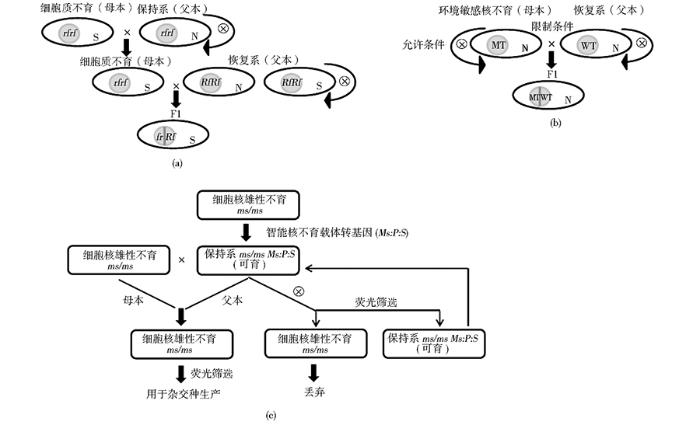
图1
雄性不育各个应用途径的示意图
Fig.1
The schematic diagram for the application of various male sterility mechanisms
(a) Three line system of cytoplasmic sterility rf: Recessive restorer gene; Rf: Dominant recessive restorer gene; N: Normal fertile cytoplasm; S: Sterile cytoplasm (b) Environment-sensitive genic male sterility MT: Mutant, WT: Wild type (c) Seed production technology ms: Recessive genetic male-sterile gene; Ms: Male fertility gene; P: Pollination disruption gene, S: Seed screenable marker gene
自从在玉米Golden June中发现了T型细胞质雄性不育以来[21],CMS成为代替人工去雄的可行选择。但是由于在20世纪70年代CMS-T型遭受小斑病T小种专化侵染,在生产中几乎停用。其他的细胞质不育类型,如CMS-S及CMS-C也渐渐被应用到商业化生产中[22], 其中CMS-S是最多的一种类型。研究证明我国玉米黄改系材料如昌7-2是S型天然的强恢复系[23],并且由于我国优良杂交种的父本多为黄改系材料,因此充分利用CMS-S能够成为快速实现不育化育种的有效途经[24]。宋伟等[23]和赵久然等 [25]以自育的S型细胞质雄性不育系MD32为供体,以玉米主栽品种京科968的母本京724为受体,利用回交转育并结合分子标记辅助育种的方法仅三代就获得了具有京724背景的S型细胞质雄性不育系。经过多点表型分析,发现京724不育系和正常京724在株高、穗位高、雄穗分支数、雄穗主轴长等农艺性状,以及穗长、穗粗、穗行数、行粒数、单穗粒重、容重等产量性状上无明显差异,表明CMS-S在利用三系配套制种中是切实可行的。目前京724不育系已经应用到了京科968杂交种的商业化生产中,大幅节省了制种成本。另外还有大量的以CMS-S为基础的三系配套杂交种制种方法已经被开发和利用,如京科528、京单38、NK718和NK917等品种[26,27,28,29]。
1954年Stephens等 [48]将milo 细胞质(命名为A1)放置于kafir核背景下形成了高粱中首个CMS系统。随后其他细胞质不育类型也在高粱中被鉴定,包括A2 (Guinea, Caudatum)[49]、A3(Durra, Caudatum, Kafir-Caudatum)[50]、A4(Guinea)[51]、Indian A4(A4 M, A4 VZM, A4G)[52]、A5 (bicolor)、A6(durra)和9E [53,54] 。在发现了A1-CMS i.e. Tifton 23A [55]之后,基于CMS的杂交育种系统在珍珠粟中得以应用。随后A2和A3-CMS也被发现和研究用以扩展珍珠粟中CMS的多样性,但是由于田间表现不理想,它们并没有被大量地应用在作物改良中[56]。另外,A4[57]及A5类型[58]的CMS也陆续在珍珠粟中被发现。
综上所述,近年来在植物细胞质雄性不育的研究中取得了显著的进展,众多CMS类型的发现促进了其在作物杂种优势和杂交种生产中的应用。但是CMS在应用中也存在一些缺陷:尽管其能够较为广泛的应用到作物杂交种制种中,但是由于CMS的效力取决于在特定细胞质环境下细胞核中育性恢复基因的有无,所以CMS并不能在所有的种质中有效。另外,CMS的育性通常不稳定,会出现一定比例的育性恢复现象,这就在一定程度上限制了CMS在作物杂种优势中的应用。
2 细胞核雄性不育及其应用
细胞核雄性不育是发生在开花植物中的自然现象[2]。在玉米中已经发现了40多个核不育基因 [64,65],其中绝大多数是隐性突变并已被定位在了相应染色体上[66]。隐性核不育基因突变体可以成为玉米、水稻、小麦和高粱等作物杂交种生产中优良的雄性不育材料。在杂交制种过程中,由于父本含有野生型等位基因,可以作为雄性不育突变体隐性等位基因的“恢复因子”,但是母本不育材料不能通过自交进行繁种,只能通过孟德尔遗传方法使用杂合体作为父本与纯合突变体杂交来获取不育系种子。利用这种方法得到的后代将有1∶1的育性分离,表现为50% 雄性不育及50%杂合可育植株。因此,这类不育系的共同特点是不育性稳定、杂交制种安全, 易于配制高产、优质、多抗组合,而缺点是无法实现不育系的批量扩繁。
随着生物技术的发展,2006年美国杜邦公司基于玉米率先开发设计了一种新型的智能不育技术(seed production technology),这种新的生物技术可以用来繁殖隐性核不育突变材料 [67]。该技术的基本原理是将花粉育性恢复基因、花粉失活(败育)基因和标记筛选基因作为紧密连锁的元件导入隐性核不育突变体中用以构建SPT保持系(图1c)。以玉米为例,SPT过程就是利用一个纯合隐性的转基因SPT保持系DP-32138-1,包含:(1)克隆的雄性不育基因(Ms45),它可以在孢子体内恢复育性;(2)一个破坏授粉的基因(zm-aa1,编码α淀粉酶),它只能在花粉中发挥作用;(3)可以筛选的荧光标记[DsRed2(Alt1)],它可以用来鉴定和帮助转基因SPT保持系种子的纯化。该SPT载体以半合子的状态整合到纯合的雄性不育突变体中。因此,由于不包含SPT元件50%的花粉是可育的,而另外的50%花粉由于含有来自SPT元件中α淀粉酶活性,淀粉耗尽而不能正常授粉。SPT保持系的育性由单拷贝的野生型Ms45所保持。由于SPT转基因元件只能由母本植物遗传,因此SPT保持系的自交可以保持SPT元件半合子状态的植株。自交结种的50%为不包含转基因的黄色种子,另外50%是包含转基因的荧光种子,这两类种子可以使用光学方法区分,将不含荧光的种子丢弃,而留下含有荧光的保持系种子。当保持系作为父本与不育系母本杂交时,同样地含有败育转基因的花粉将不能正常发育和受精,只有不含转基因元件的花粉可以正常发育和受精,得到的是不含转基因的雄性不育系,这样就实现了不育系的扩繁,可以用于大规模的杂交种生产。与其他的致雄性不育的生物技术不同,利用SPT得到的应用于制种的玉米雄性不育自交系不会从保持系遗传到SPT rDNA,因此是非转基因的,同时利用该自交系获得的商业化玉米杂交种也是非转基因的,可以不受转基因作物政策监控。对于水稻、小麦和高粱等重要的自花授粉作物来说,SPT也有着很重要的应用前景。
水稻杂交种的选育可对全球持续增加的食品需求产生正面影响。但是一直以来研发高产水稻杂交种的方法受到遗传和环境因素制约[68],只有不到30%的水稻种质能够被育种家所利用,这大大减低了杂交稻的利用和籽粒产量。近期智能不育的方法也被应用到水稻杂交种的生产过程中。水稻核不育基因OSNP1,编码葡萄糖-甲醇-胆碱氧化还原酶,可以调控绒毡层和花粉外壁的形成,并在绒毡层和小孢子内特异表达 [69]。水稻osnp1突变体能够正常营养生长,但是表现为雄性不育,且对环境不敏感。类似于玉米SPT元件,将OSNP1基因、α淀粉酶及红色荧光蛋白构建的元件整合到osnp1突变体内就可以实现保持系和不育系的高纯度扩繁,实现水稻杂交种的三系配套制种。该雄性不育系已经与约1 200个水稻种质杂交,其中85%的F1代产量超过父母本,还有10% 的F1产量甚至高于当地主推品种,表明这种技术在杂交水稻的选育和生产中具有很大前景。
在小麦中也发现了5个与GMS有关的位点,包括两个隐性的ms1和ms5,以及三个显性位点Ms2、 Ms3和Ms4,这些位点中的隐性突变基因也有潜力被智能不育技术利用在小麦杂交种雄性不育化制种中发挥作用。
3 环境敏感型雄性不育及其应用
在智能不育技术诞生以前,由于核不育系难以进行有效地保持,在商业化制种中细胞核雄性不育很难被利用。但是,环境敏感型雄性不育(EGMS)突变体的发现使一些核不育性状能够用于杂交种生产[70]。EGMS可能通过非编码RNA诱导的表观遗传调控其花粉育性在不同的环境条件下发生改变,如光周期和温度。第一个光周期敏感型(PGMS)不育突变体,农垦58S (NK58S) 于1973年在粳稻中被发现。在长日照条件下,NK58S是完全雄性不育的,然而在短日照下则表现为可育[71]。1988年,在籼稻中发现了温度敏感型雄性不育(TGMS)突变体安农S-1,其在高温下表现为完全雄性不育,而在低温下可育[72]。 PGMS和TGMS这种可逆的育性使得它们可以在杂交种生产中使用两系系统(图1b)。 特定的环境中(如长日照或者高温)环境敏感型雄性不育系可以作为母本,同时该系可以在适宜的条件(如短日照或低温)下进行自交扩繁。因此这种两系系统节省了通过杂交进行雄性不育系繁种的环节。另外,所有含有野生型育性等位基因的正常品种都能够恢复雄性不育系的育性,所以它们能够作为父本进行商业化杂交种的制备。正因如此,两系杂交系统简化了杂交种的生产过程,并且降低了成本。近来,基于PGMS或TGMS的两系杂交水稻的面积占据了全国杂交水稻总面积的20% [6]。
在水稻和小麦中还发现了一些其他的EGMS突变体,但是其中只有极少数的基因功能被鉴定。粳稻PGMS突变体NK58S主要表现为光周期敏感,但是与籼稻TGMS突变体PeiAi64S杂交后,却主要表现为光温敏感型雄性不育,控制这两个性状的基因被定位在了12号染色体的同一位置上, 表明同一基因在不同遗传背景中响应不同的环境条件[73,74,75,76]。另有研究发现,水稻PGMS突变体CSA与雄性可育籼稻的杂交F1代表现出了高产等杂种优势,表明这种可逆的PGMS突变体在杂交稻生产中具有良好的应用潜力[77]。研究人员在小麦中鉴定出了PCMS突变体Norin26,该突变体在15h及以上日照条件下表现完全的雄性不育,而小于14.5h则表现为可育[78,79,80]。 PCMS可以通过在短日照下实现自交繁种,长日照下作为母本不育系进行杂交种的生产。与CMS不同的是,利用PCMS的系统只需要PCMS系以及恢复系(提供花粉),因此PCMS也为杂交小麦的两系生产提供了有前景的育种材料。小麦中也有PGMS、TGMS以及受光周期和温度共同调控的PTGMS,这些材料使得在不同条件下实现杂交种F1的制种成为可能,尤其是在气候环境较为一致的地区。另外,也有报道称铜和硼等微量元素的缺乏会导致小麦的雄性不育,这种突变体也有可能会在作物杂种优势中得到应用。
相比于三系杂交,两系杂交育种具有明显的优点和不足。优点包括 (1) 由于不育性是由核基因控制, 因此利用范围不受种质资源的影响,从而大大提高了选育不同类型优良杂交种的概率; (2) 两系生产较大程度地简化了种子生产程序;(3) 避免了“三系法”雄性不育系的育性恢复引起的负效应,较大程度上确保了杂交种的纯度。然而该技术的缺点是:由于育性的变化与环境条件相关,制种和繁殖都受到一定的制约,而且在多代繁殖后光温敏感型核不育系的临界不育温度会发生漂移,从而导致产量和纯度降低。
4 化学诱导的雄性不育及其应用
由于细胞质雄性不育系统的不稳定性、不良连锁及对保持系的需要,同时细胞核雄性不育相对难以利用等特点,促使人们去开发更加简单、有效的方法来实现雄性不育。例如,使用化学药品或者突变剂来诱导雄性不育。由于施用简单、对种质材料无选择性及无需预杂交,化学诱导是相对方便简洁的方法。目前,有超过40种专利化学药品可以有效地诱导小麦雄性不育,其中乙醚和青鲜素是最常用的,其次是最新一代的孟山都“GENESIS”[81]。理想的雄性不育化学诱导剂一般具有以下特征:只对雄花有影响而对雌花没有影响,产生的雄性不育败育彻底,且不产生植物毒性效应;在特定作物的任意基因型和广泛的环境条件下有效;单次施用就能够达到不育效果;对F1代种子质量活性没有影响;生产成本低及对环境无害;等等。截至目前,尽管有很多化学药品能够在小麦中诱导雄性不育,但是均未能达到以上全部要求[82]。使用乙醚类化合物会使小麦节间距缩短从而导致株高降低,并影响植株发育和产量,而使用青鲜素则会对小麦植株产生伤害。因此这些化学药品并没有大范围的进行商业化应用。
随着世界人口对食品需求量的不断增长,农业科技发展已成为一项全世界的重要任务。作物杂种优势的利用和杂交种选育是目前利用最广、最有效的保障粮食供给的途径。本文介绍了4种雄性不育机制在作物杂种优势中的应用途径和它们在生产中的优劣性。对这些应用途径的研究不仅能够推动对雄性不育机制的理论研究,还能够极大地促进雄性不育在作物杂交种商业化生产中的应用,以实现高纯度杂交种的高效低成本大规模生产,为确保世界粮食供给提供技术支撑。
参考文献
Joseph gottlieb Kolreuter’s contributions to biology
Male Sterility in Higher Plants

The whole subject of male sterility in plants, a phenomenon first observed by Klreuter in 1763, is comprehensively treated in this volume, which is divided into 2 parts. Part I covers principles, generalizations and fundamental concepts, chemical induction and environmental influence, critical discussions and specific conclusions on the nature, type, inheritance, biochemistry, molecular basis,...
Molecular basis of nuclear and cytoplasmic male sterility in higher plants
Two major types of male sterility, Mendelian sterility (MST) and cytoplasmic male sterility (CMS) can be distinguished according to their genetic control. Molecular advances concerning MST arose initially from the isolation and the characterization of genes expressed specifically in anther and pollen. These genes were manipulated to induce pollen failure. MST was induced by tapetal-specific expression of different genes such as an RNase gene, a modified glucanase gene, the Agrobacterium rhizogenes rolC gene or an unedited atp9 mitochondrial gene in tobacco transformants, and by antisense inhibition of flavonoid biosynthesis in anthers of petunia transformants. Other recent data on MST molecular genetics were obtained from the analysis of three categories of mutants
Molecular control of male reproductive development and pollen fertility in rice
Breeding technologies to increase crop production in a changing world
Abstract To feed the several billion people living on this planet, the production of high-quality food must increase with reduced inputs, but this accomplishment will be particularly challenging in the face of global environmental change. Plant breeders need to focus on traits with the greatest potential to increase yield. Hence, new technologies must be developed to accelerate breeding through improving genotyping and phenotyping methods and by increasing the available genetic diversity in breeding germplasm. The most gain will come from delivering these technologies in developing countries, but the technologies will have to be economically accessible and readily disseminated. Crop improvement through breeding brings immense value relative to investment and offers an effective approach to improving food security.
Characterization and use of male sterility in hybrid rice breeding
Abstract The hybrid rice ( Oryza sativa L.) breeding that was initiated in China in the 1970s led to a great improvement in rice productivity. In general, it increases the grain yield by over 20% to the inbred rice varieties, and now hybrid rice has been widely introduced into Africa, Southern Asia and America. These hybrid varieties are generated through either three-line hybrid and two-line hybrid systems; the former is derived from cytoplasmic male sterility (CMS) and the latter derived from genic male sterility (GMS). There are three major types of CMS (HL, BT and WA) and two types of GMS (photoperiod-sensitive (PGMS) and temperature-sensitive (TGMS)). The BT- and HL-type CMS genes are characterized as orf79 and orfH79 , which are chimeric toxic genes derived from mitochondrial rearrangement. Rf3 for CMS-WA is located on chromosome 1, while Rf1, Rf4, Rf5 and Rf6 correspond to CMS-BT, CMS-WA and CMS-HL, located on chromosome 10. The Rf1 gene for BT-CMS has been cloned recently, and encodes a mitochondria-targeted PPR protein. PGMS is thought to be controlled by two recessive loci on chromosomes 7 and 12, whereas nine recessive alleles have been identified for TGMS and mapped on different chromosomes. Attention is still urgently needed to resolve the molecular complexity of male sterility to assist rice breeding.
杂交水稻育种将迎来新时代
杂种优势是生物界一种普遍的现象,在许多作物中得到应用.杂交水稻自20世纪70年代开始在中国大规模种植,对于粮食生产具有举足轻重的作用.现有的“三系法”和“两系法”杂交育种技术对粮食增产贡献巨大,但它们的技术缺陷也非常明显.本文在总结已有杂交育种技术的操作流程及优缺点的基础上,阐述了利用智能不育杂交育种技术,实现隐性雄性核不育材料在杂交水稻中应用的技术流程.这种飞跃性技术的运用将推动杂交水稻的生产进入一个新的时代.
Hybrid rice breeding welcomes a new era of molecular crop design
.杂种优势是生物界一种普遍的现象,在许多作物中得到应用.杂交水稻自20世纪70年代开始在中国大规模种植,对于粮食生产具有举足轻重的作用.现有的“三系法”和“两系法”杂交育种技术对粮食增产贡献巨大,但它们的技术缺陷也非常明显.本文在总结已有杂交育种技术的操作流程及优缺点的基础上,阐述了利用智能不育杂交育种技术,实现隐性雄性核不育材料在杂交水稻中应用的技术流程.这种飞跃性技术的运用将推动杂交水稻的生产进入一个新的时代.
植物雄性不育研究进展
Advances in plant male sterility. China Science Paper Online.[
Production of hybrid seed corn
An account is given of hybrid maize seed production as it is commercially practised in the USA in the late 1980s. The structure of the industry, the production methods used, quality assurance and storage and distribution are described in detail.
Unveiling the molecular arms race between two conflicting genomes in cytoplasmic male sterility
Cytoplasmic male sterility can be thought of as the product of a genetic conflict between two genomes that have different modes of inheritance. Male sterilizing factors, generally encoded by chimaeric mitochondrial genes, can be downregulated by specific nuclear restorer genes. The recent cloning of a restorer gene in rice and its comparison with restorer genes cloned in petunia [Petunia sp.] and radish could be regarded as the beginning of a general molecular scenario in this peculiar arms race.
Genome barriers between nuclei and mitochondria exemplified by cytoplasmic male sterility
Since plants retain genomes of an extremely large size in mitochondria (200-2,400 kb), and mitochondrial protein complexes are comprised of chimeric structures of nuclear- and mitochondrial-encoded subunits, coordination of gene expression between the nuclei and mitochondria is indispensable for sound plant development. It has been well documented that the nucleus regulates organelle gene expression. This regulation is called anterograde regulation. On the other hand, recent studies have demonstrated that signals emitted from organelles regulate nuclear gene expression. This process is known as retrograde signaling. Incompatibility caused by genome barriers between a nucleus and foreign mitochondria destines the fate of pollen to be dead in cytoplasmic male sterility (CMS), and studies of CMS confirm that pollen fertility is associated with anterograde/retrograde signaling. This review summarizes the current perspectives in CMS and fertility restoration, mainly from the viewpoint of anterograde/retrograde signaling.
Cytoplasmic male sterility and mitochondrial metabolism in plants
Cytoplasmic male sterility (CMS) is a common feature encountered in plant species. It is the result of a genomic conflict between the mitochondrial and the nuclear genomes. CMS is caused by mitochondrial encoded factors which can be counteracted by nuclear encoded factors restoring male fertility. Despite extensive work, the molecular mechanism of male sterility still remains unknown. Several studies have suggested the involvement of respiration on the disruption of pollen production through an energy deficiency. By comparing recent works on CMS and respiratory mutants, we suggest that the “ATP hypothesis” might not be as obvious as previously suggested.
Anatomy and cytology of microsporogenesis in cytoplasmic male sterile angiosperms
The studies reviewed date from 1925 to 1972 and contain extensive anatomical and cytological information all too often incomplete or vague. The terminology for microsporogenesis used is also often sketchy or inaccurate. An attempt therefore has been made to establish some consistency in microsporogenesis terminology via Fig. 1 and the tables. We have given, in convenient tabular form, CMS taxa, investigators, and the morphological and cytological events reported. By referring to a few keys, the reader can gain further insight into specific CMS taxa and can easily compare studiesThe work of Laser (1972) is only part of a more extensive investigation of the anatomy, cytology, and histochemistry of N and CMS Sorghum bicolor (Laser, unpub.). To date, only a small part is published (Christensen, Horner & Lersten, 1972), but when completed it probably will be the most complete study to date of these aspects of CMS. Hoefert (1969a, 1969b, 1971) has investigated only normal microsporogenesis so far, but her intention also is to make a detailed descriptive comparison of N and CMS development. Such comparative electron microscope studies will be needed to help answer questions raised in the Introduction of this review. Concerning the events within microspores at the beginning of abortion, for example, there is complete ignorance of what organelle shows the first sign of disintegration or whether there is a definite sequence or simply a simultaneous collapse. The answer to this question could yield valuable clues to the direct cause of abortionLooking at the existing published studies and taking into account numerous examples of questionable technique and interpretation, we conclude that abortion has been shown to occur at almost every point in development, and that probably more than one mechanism is involved...
The rice pentatricopeptide repeat protein RF5 restores fertility in hong-lian cytoplasmic male-sterile lines via a complex with the glycine-rich protein GRP162
The cytoplasmic male sterility (CMS) phenotype in plants can be reversed by the action of nuclear-encoded fertility restorer (Rf) genes. The molecular mechanism involved in Rf gene-mediated processing of CMS-associated transcripts is unclear, as are the identities of other proteins that may be involved in the CMS-Rf interaction. In this study, we cloned the restorer gene Rf5 for Hong-Lian CMS in rice and studied its fertility restoration mechanism with respect to the processing of the CMS-associated transcript atp6-orfH79. RF5, a pentatricopeptide repeat (PPR) protein, was unable to bind to this CMS-associated transcript; however, a partner protein of RF5 (GRP162, a Gly-rich protein encoding 162 amino acids) was identified to bind to atp6-orfH79. GRP162 was found to physically interact with RF5 and to bind to atp6-orfH79 via an RNA recognition motif. Furthermore, we found that RF5 and GRP162 are both components of a restoration of fertility complex (RFC) that is 400 to 500 kD in size and can cleave CMS-associated transcripts in vitro. Evidence that a PPR protein interacts directly with a Gly-rich protein to form a subunit of the RFC provides a new perspective on the molecular mechanisms underlying fertility restoration.
Male sterility and fertility restoration in crops
Abstract In plants, male sterility can be caused either by mitochondrial genes with coupled nuclear genes or by nuclear genes alone; the resulting conditions are known as cytoplasmic male sterility (CMS) and genic male sterility (GMS), respectively. CMS and GMS facilitate hybrid seed production for many crops and thus allow breeders to harness yield gains associated with hybrid vigor (heterosis). In CMS, layers of interaction between mitochondrial and nuclear genes control its male specificity, occurrence, and restoration of fertility. Environment-sensitive GMS (EGMS) mutants may involve epigenetic control by noncoding RNAs and can revert to fertility under different growth conditions, making them useful breeding materials in the hybrid seed industry. Here, we review recent research on CMS and EGMS systems in crops, summarize general models of male sterility and fertility restoration, and discuss the evolutionary significance of these reproductive systems.
禾本科植物雄性不育遗传机制与利用
雄性不育作为生殖生物学的重要性状,在植物界普遍存在,对于作物杂种优势的利用具有重要意义,在作物育种中具有重要地位。禾本科(Gramineae)植物是人类粮食和牲畜饲料的主要来源,是具有重要经济价值的大科。文章综述了禾本科植物雄性不育的类型、遗传机制、雄性不育的相关基因及其应用,总结了这方面的研究进展,重点归纳了雄性不育的相关基因,展现了雄性不育理论研究及应用的广阔前景。
Genetic mechanism and utilization of the Gramineae male sterile
.雄性不育作为生殖生物学的重要性状,在植物界普遍存在,对于作物杂种优势的利用具有重要意义,在作物育种中具有重要地位。禾本科(Gramineae)植物是人类粮食和牲畜饲料的主要来源,是具有重要经济价值的大科。文章综述了禾本科植物雄性不育的类型、遗传机制、雄性不育的相关基因及其应用,总结了这方面的研究进展,重点归纳了雄性不育的相关基因,展现了雄性不育理论研究及应用的广阔前景。
Cytoplasmic male sterility in rice. Oryza sativa L. I. Fertilities of F_1, F_2 and offsprings obtained from their mutual reciprocal backcrosses, and segregation of complete male sterile plants
Hybrid Rice Breeding in China//Innovative Approaches to Rice Breeding.
Workable male sterility systems for hybrid rice: Genetics, biochemistry, molecular biology, and utilization
The exploitation of male sterility systems has enabled the commercialization of heterosis in rice, with greatly increased yield and total production of this major staple food crop. Hybrid rice, which was adopted in the 1970s, now covers nearly 13.6 million hectares each year in China alone. Various types of cytoplasmic male sterility (CMS) and environment-conditioned genic male sterility (EGMS) systems have been applied in hybrid rice production. In this paper, recent advances in genetics, biochemistry, and molecular biology are reviewed with an emphasis on major male sterility systems in rice: five CMS systems, i.e., BT-, HL-, WA-, LD- and CW- CMS, and two EGMS systems, i.e., photoperiod- and temperature-sensitive genic male sterility (P/TGMS). The interaction of chimeric mitochondrial genes with nuclear genes causes CMS, which may be restored by restorer of fertility ( Rf ) genes. The PGMS, on the other hand, is conditioned by a non-coding RNA gene. A survey of the various CMS and EGMS lines used in hybrid rice production over the past three decades shows that the two-line system utilizing EGMS lines is playing a steadily larger role and TGMS lines predominate the current two-line system for hybrid rice production. The findings and experience gained during development and application of, and research on male sterility in rice not only advanced our understanding but also shed light on applications to other crops.
The Utilization of Male-sterile Inbred Lines in the Production of Corn Hybrids
In:Numerous inbreds have been crossed with the cytoplasmically male sterile line Tx 203Ms at the Texas Agricultural Experiment Station. Most of the resulting single crosses were completely sterile; a few showed partial fertility; three were completely fertile. Sterility has also been investigated in double crosses whose single-cross seed parents each involved a male sterile line. When one inbred c...
Identification of genes potentially associated with the fertility instability of S-type cytoplasmic male sterility in maize via bulked segregant RNA-Seq
S-type cytoplasmic male sterility (CMS-S) is the largest group among the three major types of CMS in maize. CMS-S exhibits fertility instability as a partial fertility restoration in a specific nuclear genetic background, which impedes its commercial application in hybrid breeding programs. The fertility instability phenomenon of CMS-S is controlled by several minor quantitative trait locus (QTLs), but not the major nuclear fertility restorer (Rf3). However, the gene mapping of these minor QTLs and the molecular mechanism of the genetic modifications are still unclear. Using completely sterile and partially rescued plants of fertility instable line (FIL)-B, we performed bulk segregant RNA-Seq and identified six potential associated genes in minor effect QTLs contributing to fertility instability. Analyses demonstrate that these potential associated genes may be involved in biological processes, such as floral organ differentiation and development regulation, energy metabolism and carbohydrates biosynthesis, which results in a partial anther exsertion and pollen fertility restoration in the partially rescued plants. The single nucleotide polymorphisms (SNPs) identified in two potential associated genes were validated to be related to the fertility restoration phenotype by KASP marker assays. This novel knowledge contributes to the understanding of the molecular mechanism of the partial fertility restoration of CMS-S in maize and thus helps to guide the breeding programs.
京724玉米自交系S型细胞质雄性不育系分子标记辅助选育研究
Study on breeding of new S-type cytoplasmic male sterile material from maize inbred line Jing724 with molecular marker assisted selection
玉米雄性不育系的选育方法:中国,ZL201310751112.6, 2016-01-13
.[
Maize Male Sterile Line Breeding Method: Chinese, ZL201310751112.6, 2016-01-13.
[
京科968三系配套杂交种制种方法: 中国,ZL201410493909.5, 2016-03-02
.[
Three-Line Hybrid Seed Production Methods for Jingke968: Chinese, ZL201410493909.5, 2016-03-02.
[
京科528三系配套杂交种制种方法: 中国,Z201410743446.3, 2016-03-02
.[
Three-Line Hybrid Seed Production Methods for Jingke528: Chinese, Z201410743446.3, 2016-03-02.
[
Nk718三系配套杂交种制种方法: 中国,ZL 2014 1 0493914.6, 2016-08-24
.[
Three-Line Hybrid Seed Production Methods for Nk718: Chinese, ZL 2014 1 0493914.6, 2016-08-24.
[
京单38三系配套杂交种制种方. 中国发明专利,授权号ZL 2014 1 0495420.1, 2016-08-24
.[
Three-Line Hybrid Seed Production Methods for Jingdan38: Chinese, ZL 2014 1 0495420.1, 2016-08-24.
[
NK971三系配套杂交种制种方法: 中国,ZL 2014 1 0742947.X, 2016-08-24
.[
Three-Line Hybrid Seed Production Methods for Nk971: Chinese, ZL 2014 1 0742947.X, 2016-08-24.
[
A YA‐type cytoplasmic male-sterile source in common wheat
A new cytoplasmic male-sterile (CMS) system for hybrid wheat breeding, YA-type CMS line with the cytoplasmic mutant from the common wheat variety 'CA8057', was developed by the Institute of Genetics and Developmental Biology, Chinese Academy of Sciences. The pollen sterility of YA-type CMS line was easily maintained but difficult to restore. Some sterile lines with desirable agronomic performance, such as msYA-'CA8057' (BC 17 ), msYA-'Yuandong 6' (BC 9 ), msYA-'Jin 411' (BC 9 ), msYA-'WL1' (BC 10 ), msYA-'Yanshi 9' (BC 10 ), msYA-'BPm16' (BC 9 ), msYA-'Jindong 8' (BC 9 ) and msYA-'Jinmai 33' (BC 9 ), were bred and a restorer line GR1 was screened with 26 new restorer lines being developed by transferring restorer genes from GR1. It was found that abnormal phenomena occurred at the uninucleate-pollen stage and the abortive pollen was poor in starch content and other components. The variance analysis of agronomic traits in eight sterile lines indicated that there was no general negative effect of cytoplasm. The genetic analysis for fertility restoration showed that two pairs of independent major genes (designated YA Rf 1 YA Rf 1 YAr f 2 YAr f 2 ) and some minor genes could be involved in the fertility restoration in restorer line GR1, and YA Rf 1 was epistatic over YA Rf 2 for the genetic effect of fertility restoration. As a new CMS system, the YA-type CMS line was of potential value for hybrid wheat breeding and should be further studied.
Male fertility restoration of wheat in Hordeum chilense cytoplasm is associated with 6H ch S chromosome addition
agricultural systems, agronomy, climate, sustainable, plant improvement, plant protection, water use, interaction, animal nutrition, animal breeding, plant breeding, molecular techniques, monogastric, ruminant, plant pathology, plant nutrition, crop, pasture, systems research, modelling, CSIRO, CSIRO PUBLISHING, publications, science, educational, scientific, journal, journals, Australia, Australian, international
Cytoplasmic male sterility in Brassicaceae crops
Brassicaceae crops display strong hybrid vigor, and have long been subject to F1 hybrid breeding. Because the most reliable system of F1 seed production is based on cytoplasmic male sterility (CMS), various types of CMS have been developed and adopted in practice to breed Brassicaceae oil seed and vegetable crops. CMS is a maternally inherited trait encoded in the mitochondrial genome, and the male sterile phenotype arises as a result of interaction of a mitochondrial CMS gene and a nuclear fertility restoring (Rf) gene. Therefore, CMS has been intensively investigated for gaining basic insights into molecular aspects of nuclear-mitochondrial genome interactions and for practical applications in plant breeding. Several CMS genes have been identified by molecular genetic studies, including Ogura CMS from Japanese radish, which is the most extensively studied and most widely used. In this review, we discuss Ogura CMS, and other CMS systems, and the causal mitochondrial genes for CMS. Studies on nuclear Rf genes and the cytoplasmic effects of alien cytoplasm on general crop performance are also reviewed. Finally, some of the unresolved questions about CMS are highlighted.
Molecular mapping of fertility restorer gene of an alloplasmic CMS system in Brassica juncea containing Moricandia arvensis cytoplasm
Two wheat– Thinopyrum substitution lines X479 and X482 selected from the progenies of wheat “Mianyang26 (MY26)”02×02wheat– Thinopyrum intermedium ssp. trichophorum partial amphiploid were characterized by seed storage protein electrophoresis, genomic in situ hybridization (GISH), fluorescence in situ hybridization (FISH), and PCR-based molecular markers. Seed storage protein analysis showed that X479 expressed some of Th. intermedium ssp. trichophorum -specific gliadin and glutenin bands. Chromosome counting and GISH probed by Pseudoroegneria spicata genomic DNA indicated that two pairs of Thinopyrum -derived chromosomes (St genome and St–J S translocated chromosomes) substituted for two pairs of wheat chromosomes in both X479 and X482. FISH using pAs1 and pHvG38 as probes showed that chromosomes 1B and 4B, and 4D and 6D were absent in X479 and X482, respectively. Using the newly isolated J S chromosome-specific repetitive sequence pDb12H as a probe, the FISH signals revealed that the translocation of St–J S chromosomes in X479 and X482 occurred in repetitive sequence regions of the short arm. The molecular markers based on wheat–rice colinearity confirmed that the chromosome constitutions of X479 and X482 were 1St (1B)02+024St–4J S (4B) and 4St–J S (4D)02+026St (6D), respectively. The substitution lines were both fully fertile which suggests that the Th. intermedium chromosomes in X479 and X482 substitute well for the corresponding wheat chromosomes. The rust resistance and novel agronomic traits revealed that the substitution lines will be potentially useful for genetic improvement of wheat.
Substituting nuclear genome of Brassica juncea (L.) Czern & Coss. In cytoplasmic background of Brassica fruticulosa results in cytoplasmic male sterility
Molecular mapping of the Rf 3 fertility restoration gene to facilitate its utilization in breeding confection sunflower
The inheritance of a previously identified dominant Rf gene in the confection sunflower line RHA 280 has been determined and designated as Rf 3 . This study reports the mapping of the Rf 3 locus using an F2 population of 227 individuals derived from CMS HA 89-314902×02RHA 280. Bulked segregant analysis with 624 pairs of simple sequence repeat (SSR) primers and sequence tagged site (STS) primers identified two polymorphic SSR markers each of linkage groups (LGs) 7 and 11 from a previous map. Results on 90 F2 individuals with 42 polymorphic markers of LGs 7 and 11 indicated that the Rf 3 gene was linked with eight markers on LG 7, including five SSR markers (ORS328, ORS331, ORS928, ORS966, and ORS1092) and three expressed sequence tag (EST)-SSR markers (HT619-1, HT619-2, and HT1013). Further analysis of the total F2 population of 227 individuals identified a co-dominant marker, ORS328, linked to Rf 3 at a genetic distance of 0.702cM on one side, and a female-dominant marker HT1013 at 12.602cM proximal to Rf 3 on the other side; a genetic distance of 47.102cM for LG 7 was covered. This is the first report of an Rf gene from the confection sunflower. The closely linked marker to Rf 3 will facilitate marker-assisted selection, and provide a basis for cloning of this gene.
Maintenance of male sterility and fertility restoration in different CMS sources of sunflower (Helianthus annuus L.)
Fertility restoration in three diverse CMS sources of sunflower was studied using fifty inbreds (testers). While 22 inbreds maintained sterility of CMS PET 1 and CMS ARG 1, 28 inbreds restored their fertility. The third CMS line GIG 1, was maintained by all the inbreds indicating involvement of different gene(s). Most of the commercial sunflower hybrids are been produced using CMS PET 1. Now with the identification of restorers for CMS ARG 1, new more productive commercial hybrids can be produced. Efforts should be made to locate restorers for CMS GIG 1 for its utilization in production of sunflower hybrids.
Studies on cytoplasmic-nuclear male sterile soybean
栽培大豆双亲基因互作型不育材料的发现及其遗传推断
1990年发现两个杂交组合的F1表现不育。随即对这两个组合的后代进行追踪观察,确认了这种不育性是可以遗传的。1992年有目的的选用6个品种(系)进行了双列式完全杂交,获得6个不育组合和相应的3个反应组合,从正反交的结果看,是双亲基因工作的结果,估计可能是质核基因互作引起的不育,且表现为显性。造成不育的母本效应来源于同一个母本家系,而父本效应来源复杂且广泛。
Discovery of male sterility resulted from parental interactionin cultivated soybean and its genetic inference
1990年发现两个杂交组合的F1表现不育。随即对这两个组合的后代进行追踪观察,确认了这种不育性是可以遗传的。1992年有目的的选用6个品种(系)进行了双列式完全杂交,获得6个不育组合和相应的3个反应组合,从正反交的结果看,是双亲基因工作的结果,估计可能是质核基因互作引起的不育,且表现为显性。造成不育的母本效应来源于同一个母本家系,而父本效应来源复杂且广泛。
Development and verification of the cytoplasmic-nuclear male sterile soybean line NJCMS1A and its maintainer NJCMS1B
THE first cytoplasmic male sterile soybean line was reported by Davis in a U.S. Patent, but no further information has been released since then. Sun et al. developed a cytoplasmic-nuclear male sterile soy-
The development and preliminary studies on cytoplasmic male sterile soybean line ZA
It is very important for both of the investigation of cytoplasmic male sterile soybean and the hybrid soybean production to develop and search for the male sterile cytoplasm with diversified sources. The data from test crosses of this study verified the existence of male sterile cytoplasm in soybean line ZD8319.Based on the cytoplasm of ZD8319 a CMS soybean line, its maintainer and restorers were developed. Another soybean line carrying male sterile cytoplasm was also discovered.
A report on the nuclear cytoplasmic male sterility from a cross between two soybean cultivars. Soybean Genetics Newsletter.[
大豆质核互作不育系W931A的选育研究
Selection and breding of nucleo-cytoplasmic male sterile line W931A in soybean
Production and evaluation of hybrid soybean
Hybrids, which exploit the phenomenon termed hybrid vigor or heterosis, have proven to be a practical method of crop improvement. Hybrid autogamous legumes for commercialization have received limited attention. Soybean is an autogamous legume species. Manual cross-pollination to provide large quantities of hybrid seed is difficult and time consuming. This method is acceptable to plant breeding studies but is not acceptable for commercialization. Our goal was to review soybean flower morphology, pollination mechanisms within the genus Glycine, and present sources of male-sterile genes and cytoplasms, and to give examples of their use in plant breeding. The last section will cover heterosis in soybean and the potential for commercial production of hybrid soybean. The soybean flower has all the features that are in agreement with entomophilous characteristics of plants. In the United States, honeybees and alfalfa leafcutter bees, while certain native thrip species in China, may be the most effective in soybean cross-pollinations. Both nuclear and cytoplasmic-nuclear sterility systems are known. With appropriate selectable markers, nuclear systems may be successful. With appropriate restorer genes, nuclear-cytoplasmic systems could be successful. Both systems are under development for commercialization. The heterosis of various soybean parental combinations has not been adequately evaluated. Ten percent or more heterosis, when combined with "gene stacking", seems to be the preferred method for the first generation of commercially available soybean hybrids. The most formidable problem to commercial production is the difficulty in producing large quantities of hybrid seed.
Inheritance of male fertility restoration of the cytoplasmic-nuclear male-sterile line NJCMS1A of soybean [Glycine max (L) Merr.]
At present, no report on inheritance of male fertility restoration has been released, yet more than 10 cytoplasmic-nuclear male-sterile soybean lines as well as their maintainers and restorers have been developed. Based on our previous work, 25 restorers for the male-sterile line NJCMS1A were identified and the inheritance of male fertility restoration for these restorers was studied. The results showed that F 1 s between NJCMS1A and its restorers were completely male-fertile. The numbers of fertile and sterile plants in the F 2 population of Cross I (NJCMS1A N23601) and Cross II (NJCMS1A N23683) corresponded to a segregation ratio of 15:1, and the numbers of non-segregation lines, 3:1 segregation lines and 15:1 segregation lines in F 2:3 of the same two crosses fitted a 7:4:4 genotypic segregation ratio. The testcross BC 1 F 1 s between the F 1 s of the above two crosses and NJCMS1A, NJCMS1B showed a 3:1 segregation ratio. Accordingly, it was inferred that two pairs of duplicate dominant genes controlled the male fertility restoration of NJCMS1A in both crosses. Meanwhile, F 2 of other 23 crosses between NJCMS1A and its 23 restorers showed a fertility segregation ratio of 3:1 or 15:1. The F 1 s of the five testcrosses between NJCMS1A and the F 1 s of five crosses selected from the above 23 crosses showed that fertility segregation was 3:1 in BC 1 F 1 s between NJCMS1A and F 1 s of the crosses of which fertility segregation fitted 15:1 in F 2 population, while fertility segregation in BC 1 F 1 s was 1:1 for those fertility segregation fitted 3:1 in F 2 population. Allelism tests showed that restore genes of all restorers in the experiment were allelic to two pairs of dominant genes. All results showed that some restorers bore one pair of dominant restore gene and the others bore two pairs of duplicate dominant gene. The mechanism of F 1 male sterility of the cross N8855 N2899 was discussed.
Discovery of new male-sterile cytoplasm sources and development of a new cytoplasmic-nuclear male-sterile line NJCMS3A in soybean
Most of the cytoplasmic-nuclear male-sterile (CMS) lines of soybean were developed only from a limited cytoplasm sources and performed not as good as required in hybrid seed production, therefore, to explore new male-sterile cytoplasm sources should be one of the effective ways to improve the pollination and hybridization for a better pod-set in utilization of heterosis of soybeans. In the present study, total 80 crosses between 70 cultivated and annual wild soybean accessions and three maintainers (N2899, N21249, and N23998) of NJCMS1A were made for detecting potential new sources with male-sterile cytoplasm. The results showed that in addition to the crosses with N8855.1 (the cytoplasm donor parent of NJCMS1A) and its derived line NG99-893 as cytoplasm parent, there appeared three crosses, including N2156602×02N21249 and N2316802×02N21249, with male-sterile plants in their progenies. According to the male fertility performance of backcrosses and reciprocal crosses with the tester N21249, the landrace N21566 and annual wild soybean accession N23168 were further confirmed to have male-sterile cytoplasm. Accordingly, it was understood that the source with male-sterile cytoplasm in soybean gene pool might be not occasional. The results also showed that the genetic system of male sterility of the newly found cytoplasm source N21566 was different from the old cytoplasm source N8855.1, while N23168 was to be further studied. Based on the above results, the derived male-sterile plants from [(N2156602× N21249) F 102 × 02 N21249] BC 1 F 1 were back-crossed with the recurrent parent N21249 for five successive times, and a new CMS line and its maintainer line, designated as NJCMS3A and NJCMS3B, respectively, were obtained. NJCMS3A had normal female fertility and stable male sterility. Its microspore abortion was mainly at middle uninucleate stage, earlier than that of NJCMS1A and NJCMS2A. The male fertility of F 1 s between NJCMS3A and 20 pollen parents showed that 7 accessions could restore its male fertility and other 13 could maintain its male sterility. The male sterility of NJCMS3A and its restoration were controlled by one pair of gametophyte male-sterile gene according to male fertility segregation of crosses between NJCMS3A and three restorers. The nuclear gene(s) of male sterility in NJCMS3A appeared different from the previously reported CMS lines, NJCMS1A and NJCMS2A. The development of NJCMS3A demonstrated the feasibility to discover new CMS system through choosing maintainers with suitable nuclear background.
Molecular mapping of a fertility restorer gene for cytoplasmic male sterility in soybean
Abstract With 2 figures and 2 tables Abstract In this study, we report the mapping of the Rf locus in soybean by microsatellite simple sequence repeat (SSR) genetic markers. A cross was made between cytoplasmic male sterility (CMS) line JLCMS82A and restorer line JIHUI 1 based on the DNA polymorphisms revealed by 109 SSR markers. A F 2 population derived from a single F 1 plant containing 103 individuals was used for mapping the Rf locus. The Rf gene of JIHUI 1 gametophytically restores male fertility to JLCMS82A. Fertile and semi-fertile DNA bulks and parental DNAs were screened with 219 SSR markers, and Satt215 which was previously mapped to soybean LG J, was found linked to the Rf gene. Five additional polymorphic SSR markers from LG J were used for analysis and a regional linkage map around the Rf locus was established. SSR markers, Sctt011 and Satt547, flanked the Rf locus at 3.6cM and 5.4cM, respectively. The availability of these SSR markers will facilitate the selection of restorer lines in hybrid soybean breeding.
Male sterility in soybean (Glycine max). I. phenotypic expression of the ms2 mutant
Observations on the reproductive biology of a male-sterile mutant (ms4) of soybean, Glycine max (L.) Merr., demonstrated that male sterility was the result of a syndrome of abnormalities that influenced the function of the postmeiotic microspore mother cells (MMCs). Cytokinesis following telophase II was absent, incomplete, or disoriented, resulting in cells with different numbers of nuclei. Postmeiotic cells demonstrated various abnormalities in the formation of pollen walls. The nature of the exine ranged from absence through amorphous accumulations of sporopollenin to stratified layers. Infrequently, anther locules functioned properly, and normal pollen was differentiated. The extent and frequency of cytokinesis varied both between and within locules of single anthers. Temperature influenced the frequency of cytokinesis. At temperatures of 35 C day/32 C night, cytokinesis did not occur. Male sterility was concluded to result from the cumulative effects of various abnormalities, all of which involve functions of the postmeiotic MMCs' plasmalemmas.
Cytoplasmic male-sterility for hybrid sorghum seed production
Cytoplasmic-genic male-sterility systems in sorghum
Essentially all sorghum, (L.) Moench, hybrids are made with a single cytoplasmic-genic sterility system. In an attempt to derive new cytoplasmic-genic male-sterility systems in sorghum, recently introduced lines of diverse types from widespread geographic locations were intercrossed and backcrossed. Three male sterile from this program were tested to determine their cytoplasmic diversity for induction of male sterility. Fertility of the Fhybrids from crosses of each sterile line with a series of tester lines was compared with fertility of hybrids from crosses of a currently used sterile (‘A Tx3197’) with the same testers. Differential sterility responses indicated that each of these cytoplasms probably differ from milo cytoplasm of A Tx3197. Of these, the line with IS 12662C cytoplasm is the most desirable sterile and has been released as ‘A2 Tx2753’. Differential sterility responses among the three steriles also indicated possible cytoplasmic differences among them. Because each of these steriles was in an early generation and differed in nuclear genes, definitive conclusions must await the testing of more nearly isocytoplasmic lines developed by incorporating a common nuclear genotype into each cytoplasmic source.
Interaction of Genes and Cytoplasms in Male Sterility in Sorghum//35th Annual Corn and Sorghum Research Conference
Chicago: American Seed Trade Association, Corn and Sorghum Division,
Relationships among male-sterility inducing cytoplasms of sorghum
Cytoplasmic-nuclear male steriles are used as female parents in the production of hybrid seed of sorghum, Sorghum bicolor (L.) Moench. A single male-sterility inducing cytoplasm is most often used in the female parents, resulting in uniformity of cytoplasm in hybrids and also a restriction on nuclear diversity. The purpose of the present study was to identify diverse malesterility inducing cytoplasms. Seed set and other characteristics of hybrids of sorghum were studied to determine differences in fertility response and related characteristics among the cytoplasms of male-sterile female parents. Thirteen near-isonuclear female parents with cytoplasms from diverse introduced sources were crossed by eight male parents, and the progeny were grown at eight locations. From seed-set, anther, and pollen characteristics five groups were identified. Cytoplasms from IS6271C, IS2266C, IS3579C, IS7502C, and IS6705C were not distinguished from milo cytoplasm. Cytoplasm from IS12662C differed from milo in degree of fertility restoration in hybrids and was somewhat similar to IS3063C, IS1056C, and IS2801C. Another group, composed of IS1112C and IS12565C, was distinct in that most male parents produced highly sterile hybrids when crossed with these male steriles. Another cytoplasm, from IS7920C, differed from all the other cytoplasmstudied in its effects on seed-set, anther, and pollen characteristics. It is concluded that among these cytoplasms there are at least four distinct groups in their effects on fertility characteristics. They have potential for providing diversity among parents and hybrids in sorghum, but their utility for such purposes remains to be tested.
Genetic analysis of cytoplasmic systems in sorghum. Indian Journal of Genetics & Plant Breeding
[
Breeding behavior and histological structure of a nondehiscent anther Character in Sorghum Vulgare Pers
Research Agronomist, Cereal Crops Division, ARS, USDA, University of Nebraska
Registration of seven isocytoplasmic Sorghum germplasm lines1 (Reg. Nos. GP 9 to GP 15)
Research Division, Agricultural Research Service, US Department of Agriculture, in 1971 releasedseven grain sorghum Registered by the Crop Science Society of America. REGISTRATION OFD6647, D6654, D6659, AND D6660 DURUM WHEAT GERMPLASM ~ (Reg. No.
Cytoplasmic male-sterility in pearl millet (Pennisetum glaucum) (L.) R. Br.1
Commerical viability of alternative cytoplasmic-nuclear male-sterility systems in pearl millet
Commercial viability of three cytoplasmic-nuclear male sterility (CMS) systems (A 4 , A 5 and A v ) as potential alternatives to the most widely used A 1 system in pearl millet ( Pennisetum glaucum (L.) R.Br.) was evaluated in terms of stability of complete male sterility of four isonuclear A-lines (81A 1 , 81A 4 , 81A 5 and 81A v ) and the level and stability of male fertility restoration of their 44 single-cross hybrids. Lines 81A 4 and 81A 5 had no pollen shedders (PS), and there were very low frequency of non-PS plants of these A-lines that had a maximum of 1-5% selfed seedset (SSS). In 81A 1 and 81A v ,there were, albeit low frequency (<1%) of PS plants, and relatively higher frequency of the non-PS plants in these two lines, the more so in 81A v ,had 1-5% and even greater SSS. Some hybrids made on each of the three A-lines (81A 1 , 81A 4 and 81A v ) had high and stable male fertility, while others made on the same three A-lines displayed large variation in SSS across the environments, the more so in case of hybrids made on 81A v . These results indicate that the A 4 CMS system provides a better alternative to the A 1 CMS system, while the A v system does not. On the basis of highly stable male sterility and the highest frequency of pollinators behaving as maintainers, the A 5 CMS system appeared to be the best for A-line breeding. The commercial viability of this CMS system in breeding R-lines of grain hybrids, however, still remains to be ascertained as no hybrid on it was fully male fertile in any environment.
Characteristics and stability of a new cytoplasmic-nuclear male-Sserile source in pearl millet
Abstract The A{sub 1} cytoplasm in pearl millet, Pennisetum glaucum (L.) R. Br., is widely used buy produces fertile revertants. The objectives of this study were to evaluate the stability of male sterility in a cytoplasm (A{sub m}) transferred from P. glaucum (L.) R. Br. subspecies monodii (Maire) Brunken and to determine if this cytoplasm differed from the A{sub 1}, A{sub 2}, and A{sub 3} cytoplasms. In 1983, seeds of male-sterile Tift 23A{sub 1} and Tift 23a{sub m} were stored at 24, 5, and {minus}5{degree}C. In 1984 to 1986, seeds of each line were planted in the field and observed daily at anthesis for fertile revertants. Male sterility of the line with A{sub m} cytoplasm is maintained by the maintainer lines of A{sub 1}, A{sub 2}, and A{sub 3} cytoplasma. Seven tester lines restored full or partial male fertility to hybrids with A{sub 1}, A{sub 2}, and A{sub 3} cytoplasms but only two of the testers restored male fertility to hybrids with A{sub m} cytoplasm. Plants with A{sub 1} cytoplasm are 2 or 3 earlier than plants with A{sub 1} cytoplasm and have darker red anthers than those with A{sub 1} cytoplasm. In 3 yr, male-sterile plants with A{sub 1} cytoplasm averaged 0.91 fertile revertant events per 1000 inflorescences, while no fertile revertants were observed for plants with A{sub m} cytoplasm. The number of fertile revertants for A{sub 1} cytoplasm increased with age of seed from 1 to 3 yr. Seeds stored at 24{degree}C produced plants with significantly more fertile revertants than seeds stored at 5 or {minus}5{degree}C. Differences in seed germination and vigor of seedlings with A{sub 1} and A{sub m} cytoplasms were nonsignificant or of little practical significance. The new cytoplasm, designated A{sub 4}, is different from A{sub 1}, A{sub 2}, and A{sub 3} cytoplasms based on fertility of hybrids, morphological characters, and stability.
A new cytoplasmic-nuclear male sterility system in pearl millet
Abstract Among the cytoplasmic-nuclear male sterility (CMS) systems reported in pearl millet, Pennisetum glaucum (L.) R. Br., the A m = A 4 system produces the highest frequency of male-sterile hybrids. A CMS source identified in a large-seeded gene pool (LSGP) was compared with the A 4 system. Seven diverse restorer lines of the A4 system produced hybrids with 81A4 that were all fertile (pollen-shedding score 4 and 68–89% selfed seedset). In contrast, all the hybrids of these inbreds made with the isonuclear line with the LSGP cytoplasm were sterile (pollen-shedding score 1 and 0–3% selfed seedset). Topcross hybrids of four diverse composites made with 81A4 had 10–35% plants that had good fertility (> 50% selfed seedset). In comparison, no plant of any topcross hybrid with the isonuclear line having LSGP cytoplasm exceeded 20% selfed seedset, and it was rare for a plant to exceed even 10% selfed seedset. These differential fertility restoration patterns of hybrids indicate that the LSGP cytoplasm represents a CMS system that is different from the A4 and, by implication, from all those reported to date. This new CMS system is designated A 5 .
Male sterility from Gossypium harknessii
Male sterility and hybrid production technology
This chapter discusses the efforts made in the study of male sterility systems and their application in the development of hybrid varieties of various food legume crops (adzuki bean, chickpea, common bean, cowpea, faba bean, mung bean, pigeon pea and soyabean).
Harnessing the potential of crop wild relatives through genomics tools for pigeonpea improvement
Cultivated pigeonpea germplasm has a narrow genetic base due to the bottlenecks caused by domestication and breeding from a small number of genotypes. Pigeonpea genetic improvement has witnessed a slow pace due to low genetic diversity and to the scarce genomics resources. To address these challenges, wild relatives of pigeonpea which represent an unexploited resource of vast genetic variation can be incorporated in breeding programmes facilitating the broadening of genetic base. Although interspecific hybridization has not been commercially successful in pigeonpea, it has played an important role in the development of the cytoplasmic male sterility (CMS) system. Recent years however have witnessed the development of genomics resources at large scale in the crop which has remained untouched with genomics revolution in the past. These resources, together with advances in genomics platform such as high throughput genotyping assays and next generation sequencing technologies and modern genetics and breeding approaches will accelerate harnessing natural variation for pigeonpea improvement.
Male-sterility systems in pigeonpea and their role in enhancing yield
Abstract Top of page Abstract Genetic Male-Sterility (GMS) Systems in Pigeonpea Cytoplasmic-Nuclear Male-Sterility (CMS) Systems in Pigeonpea Blockages in Microsporogenesis of Male-Sterile Genotypes Inheritance of Male-Sterility and Fertility Restoration Systems Effect of Environment on Male-Sterility Systems Molecular Characterization of Male-Sterile Lines Utilization of Male-Sterility Systems in Pigeonpea Breeding Summary and Outlook Acknowledgements References With 1 figure and 4 tables Abstract Male-sterility has been successfully used for enhancing yield in a number of cereal and vegetable crops. In food legumes, this technology could never be used either due to non-availability of natural out-crossing system, or an efficient male-sterility system or both. Pigeonpea [ Cajanus cajan (L.) Millsp.] is a partially cross-pollinated food legume and recent success in breeding a stable male-sterility system has allowed breeders to exploit hybrid vigour for increasing yields. The cytoplasmic-nuclear male-sterility (CMS)-based hybrids have recorded 28.4% yield superiority over local checks in farmers' fields. This paper besides summarizing the reports of all the genetic and CMS systems, also discusses the prospects of utilizing these male-sterility systems in commercial hybrid breeding programmes.
ICPH 2671 – the world’s first commercial food legume hybrid
Developmental cytology of 13 genetic male sterile loci in maize
Thirteen nonallelic genetic-male sterile loci of maize (Zea mays L.) were investigated cytologically to determine the microsporogenesis breakdown characteristics for each mutant. These male-sterile mutants included ms1, ms2, ms5, ms6, ms7, ms8, ms9, ms10, ms11, ms12, ms13, ms14, and ms17 in A632 and 0h43 inbred backgrounds. Male-sterile mutants ms8 and ms9 resulted in abnormal microspore (pollen) mother cells that exhibited nearly normal nuclear development but abnormal cellular development. These mutants had the earliest effect on microsporogenesis. Male-sterile mutants ms5, ms11, and ms14 had the latest effect on microsporogenesis in that microspores developed until the microspore mitosis stage. Other male-sterile mutants seemed to have similar expressions when compared with each other. Mutants ms2 and ms7 both lacked significant microspore wall formation at the time of microspore collapse. Mutants ms10 and ms13 were similar in that the microspore wall developed to approximately one-half the normal thickness before microspore collapse. A unique feature of ms1 was the occurrence of an abnormally thickened microspore wall. Almost complete microspore wall development occurred in ms12 plants despite nuclear degradation. Mutant ms6 was cytologically and genetically similar to polymitotic (po). Mutant ms17 had variable expression that most notably affected spindle formation. These observations may be useful in utilizing genetic male sterility in maize hybrid seed production schemes.
Development of a novel recessive genetic male sterility system for hybrid seed production in maize and other cross‐pollinating crops
We have developed a novel hybridization platform that utilizes nuclear male sterility to produce hybrids in maize and other cross‐pollinating crops. A key component of this platform is a process termed Seed Production Technology (SPT). This process incorporates a transgenic SPT maintainer line capable of propagating nontransgenic nuclear male‐sterile lines for use as female parents in hybrid production. The maize SPT maintainer line is a homozygous recessive male sterile transformed with a SPT construct containing (i) a complementary wild‐type male fertility gene to restore fertility, (ii) an α‐amylase gene to disrupt pollination and (iii) a seed colour marker gene. The sporophytic wild‐type allele complements the recessive mutation, enabling the development of pollen grains, all of which carry the recessive allele but with only half carrying the SPT transgenes. Pollen grains with the SPT transgenes exhibit starch depletion resulting from expression of α‐amylase and are unable to germinate. Pollen grains that do not carry the SPT transgenes are nontransgenic and are able to fertilize homozygous mutant plants, resulting in nontransgenic male‐sterile progeny for use as female parents. Because transgenic SPT maintainer seeds express a red fluorescent protein, they can be detected and efficiently separated from seeds that do not contain the SPT transgenes by mechanical colour sorting. The SPT process has the potential to replace current approaches to pollen control in commercial maize hybrid seed production. It also has important applications for other cross‐pollinating crops where it can unlock the potential for greater hybrid productivity through expanding the parental germplasm pool.
Construction of a male sterility system for hybrid rice breeding and seed production using a nuclear male sterility gene
The breeding and large-scale adoption of hybrid seeds is an important achievement in agriculture. Rice hybrid seed production uses cytoplasmic male sterile lines or photoperiod/thermo-sensitive genic male sterile lines (PTGMS) as female parent. Cytoplasmic male sterile lines are propagated via cross-pollination by corresponding maintainer lines, whereas PTGMS lines are propagated...
Environment-sensitive genic male sterility (EGMS) in crops
The discovery and study of the photosensitive recessive male-sterile rice (oryza sative L.subsp.japonica)
In 1973, in the field of the single cropping late Geng-type rice(Oryza sativa L. subsP. japonica) var. cv. Nongken 58, the author found one spontaneous male-sterile plant, which shows male-sterile under long-day condition and fertile under short-day condition. In 1984, Dr. Deng Jingyang of the Chinese Academy of Agricultural Sciences made analysis of the data obtained in many years with the scientists of Hubei Province, and recognized this material as controlled by a pair of photosensitive recessive male-sterile key-genes not hitherto reported at home or abroad. So Dr. Deng named it as "Hubei photosensitive genic male-sterile rice", This sterile material can reproduce itself by selfing under short-day condition, and crosses can be made under long-day condition to produce F_1 hybrids. In crosses, all Geng-type rice varieties can be used as pollen-donors, the fertility of F_1 hybrids is normal, so it is advantageous for extensive screening of vigorous heterosis combinations, and besides, this material can be used as an efficient breeding tool in rice hybridization.
An overview of research and utilization of annong S1
Annong S1 is the first indica TGMS line in rice discovered and developed inside and outside China, which opens up a new way to the utilization of heterosis in rice. The researches on its reaction to temperature and light in fertility expression, inheritance of its sterility and its physiologicalbiochemical characteristics were reviewed. The utilization of it in twoline hybrid rice breeding and its prospect were summarized and discussed.
A long noncoding RNA regulates photoperiod-sensitive male sterility, an essential component of hybrid rice
Localization of pms3, a gene for photoperiod-sensitive genic male sterility, to a 28.4-kb DNA fragment
Photoperiod-sensitive genic male-sterile (PSGMS) rice, in which pollen fertility is regulated by day-length, originally arose as a natural mutant in the rice cultivar Nongken 58 ( Oryza sativa ssp. japonica ). Previous studies identified pms3 on chromosome 12 as the locus of the original PSGMS mutation. In this study we have assigned the pms3 locus to a 28.4-kb DNA fragment by genetic and physical mapping. A cross between Nongken 58S (PSGMS line) and DH80 was used to produce an F 2 population of about 7000 plants, from which 892 highly sterile individuals were obtained for recombination analysis. By analyzing recombination events in the sterile individuals using a total of 157 RFLP probes from a BAC contig covering the pms3 region, the pms3 locus was localized to a sub-region of less than 1.7 cM. Further analysis of recombination events using 49 additional probes isolated from this sub-region identified markers flanking the pms3 region on each side; these markers are only 28.4-kb apart. Sequence analysis of this fragment predicted the presence of five ORFs, found high homology with two ESTs in public databases, and detected three SNPs between the mutant and the wild-type parents, which may be helpful for identifying a candidate gene for pms3 .
Nuclear restoration of cytoplasmic male sterility in sunflower is associated with the tissue-specific regulation of a novel mitochondrial gene
We have previously shown that cytoplasmic male sterility in sunflower is associated with the insertion into the mitochondrial DNA of a novel open reading frame (ORF) located 3' to the atpA gene. Here, we show that in mitochondria from the sterile line, this novel ORF (ORF522) is cotranscribed with atpA. We have identified the product of the ORF522 as being a 15 kDa protein previously observed in sterile plant mitochondria by in organello translation. Both Western blot analysis and in organello translation assays show reduced levels of the 15 kDa polypeptide upon restoration of fertility. Interestingly, this reduction is tissue specific since it is only observed in the male florets from restored hybrid plants. These results suggest that the 15 kDa novel polypeptide is probably responsible for the CMS phenotype. Northern blot analysis using RNA from both seedlings and male florets shows a flower-specific reduction in the level of the ORF522 transcript in the restored hybrid line. The reduction is not due to a reduced transcription rate as demonstrated by 'run-on' experiments using mitochondria isolated from male florets. This suggests that the product of the nuclear restorer gene acts at the post-transcriptional level to destabilize the novel mitochondrial transcript in a tissue-specific manner and restore male fertility.
Photoperiod-and thermo-sensitive genic male sterility in rice are caused by a point mutation in a novel noncoding RNA that produces a small RNA
Mutation in CSA creates a new photoperiod-sensitive genic male sterile line applicable for hybrid rice seed production
Rice is a major staple food worldwide. Making hybrid rice has proved to be an effective strategy to significantly increase grain yield. Current hybrid rice technologies rely on male sterile lines and have been used predominantly in indica cultivars. However, intrinsic problems exist in the implementation of these technologies, such as limited germplasms and unpredictable conversions from sterility to fertility in the field. Here, we describe a photoperiod-controlled male sterile line, carbon starved anther (csa), which contains a mutation in an R2R3 MYB transcription regulator of pollen development. This mutation was introduced into indica and japonica rice, and it rendered male sterility under short-day conditions and male fertility under long-day conditions in both lines. Furthermore, F(1) plants of csa and a restorer line JP69 exhibited heterosis (hybrid vigor), suggesting the feasibility of using this mutation to create hybrid rice. The csa-based photoperiod-sensitive male sterile line allows the establishment of a stable two-line hybrid system, which promises to have a significant impact on agriculture.
Pistillody is caused by alterations to the class-B MADS-box gene expression pattern in alloplasmic wheats
Pistillody, homeotic transformation of stamens into pistil‐like structures, caused by nuclear-cytoplasm interaction in wheat
Photoperiod-sensitive cytoplasmic male sterility in wheat: nuclear-mitochondrial incompatibility results in differential processing of the mitochondrial orf25 gene
An alloplasmic wheat line with the cytoplasm of Aegilops crassa expresses photoperiod-sensitive cytoplasmic male sterility (PCMS). Southern- and Northern-hybridization analyses showed that this line contains alterations in both the gene structure and transcription patterns of the mitochondrial gene orf25. In this study, the nucleotide sequence around the orf25 gene of Ae. crassa (CR-orf25) and common wheat (AE-orf25) was determined, and we found that the upstream region of CR-orf25 had been replaced by that of rps7 of common wheat (AE-rps7) through recombination. A novel open reading frame (orf48) is present upstream of CR-orf25. In these three genes, transcription was initiated from the consensus promoter motif of plant mitochondrial genes located in the upstream regions. Processing enzymes in Ae. crassa and common wheat cleave the respective precursor mRNAs, namely CR-orf25 and AE-rps7, at sites similar to that of the premature mitochondrial 26S rRNA. In contrast, the precursor mRNA is not effectively processed at the target sequence of CR-orf25 in the alloplasmic wheat line. Because major transcripts of the euplasmic CR-orf25 and AE-rps7 genes would result in a truncated orf48 product, one possibility is that the orf48 protein might disturb mitochondrial function at a specific stage and hence affect the expression of the PCMS trait.
Male sterility systems in wheat and opportunities for hybrid wheat development
The common wheat ( Triticum aestivum L.) is a poly(hexa)ploid, derived from an amphi-diploidization process involving the donor species Triticum urartu , Aegilops speltoides , Triticum turgidum , and Aegilops tauschii . The genetic diversity of the autogamous wheat is narrow, which is a major reason for lesser rate of yield gain in wheat, in contrast to rice and maize. It is desirable to encourage hybrid breeding, i.e., combining different lines into genetically divergent heterotic pools. Thus, hybrid plants are a unique combination of desired alleles produced by crossing between genetically different parental lines. Hybrid seed production in a crop requires male-sterile female parents along with a reliable outcrossing system. The male-sterile female parent prevents pollen shedding and self-fertilization, maintaining the purity of hybrid seeds. An outcrossing system enhances hybrid seed production. This article emphasizes the biological relevance of crossbreeding and self-pollination in wheat, and reviews different male sterility systems which could be utilized for the development of hybrid wheat. Several biotechnological approaches and their practical utility in generating cross-compatible male-sterile female parent lines have been discussed.
A comparison of cytoplasmic and chemically-induced male sterility systems for hybrid seed production in wheat (Triticum aestivum L.)
A comparison of two male sterility systems was carried out in wheat for hybrid seed production and hybrid performance. Seventeen hybrid combinations based on Triticum timopheevi cytoplasm were compared with their genetically equivalent CHA-facilitated combinations. The same set of restorer lines was used as parents in CMS- and CHA-based hybrids to maintain genetic equivalence. In the first experiment aimed at study of female line behavior and crossed seed production, the CHA treated lines showed significantly shorter heights whereas CMS lines were similar to the control. The two systems were equally effective in sterilizing rate. The outcrossing percentage of the CMS lines was almost twice that of the CHA treated lines. Thousand-grain weight of the crossed seeds on CMS lines was greater than on the CHA treated lines and control. On average, the germination percentage of seeds on CMS lines was double that of the CHA treated lines and the percentage of effective outcrossed seeds in CMS lines was 3 times more than that from CHA treated lines. The second experiment was conducted to examine the yield performance of the hybrids derived from the two systems of male sterility. A total of 40 entries including 20 hybrids and 20 parents were evaluated in the experiment. The mean grain yield of the CMS-based hybrids was greater than that of the CHA-based hybrids,the B and R lines. All the CMS-based hybrids showed significantly higher grain yields than their better parents whereas all the CHA-based hybrids, except two,showed no significant yield increases over their better parents. Possible reasons for differences in CMS- and CHA-based hybrid performance are discussed.


