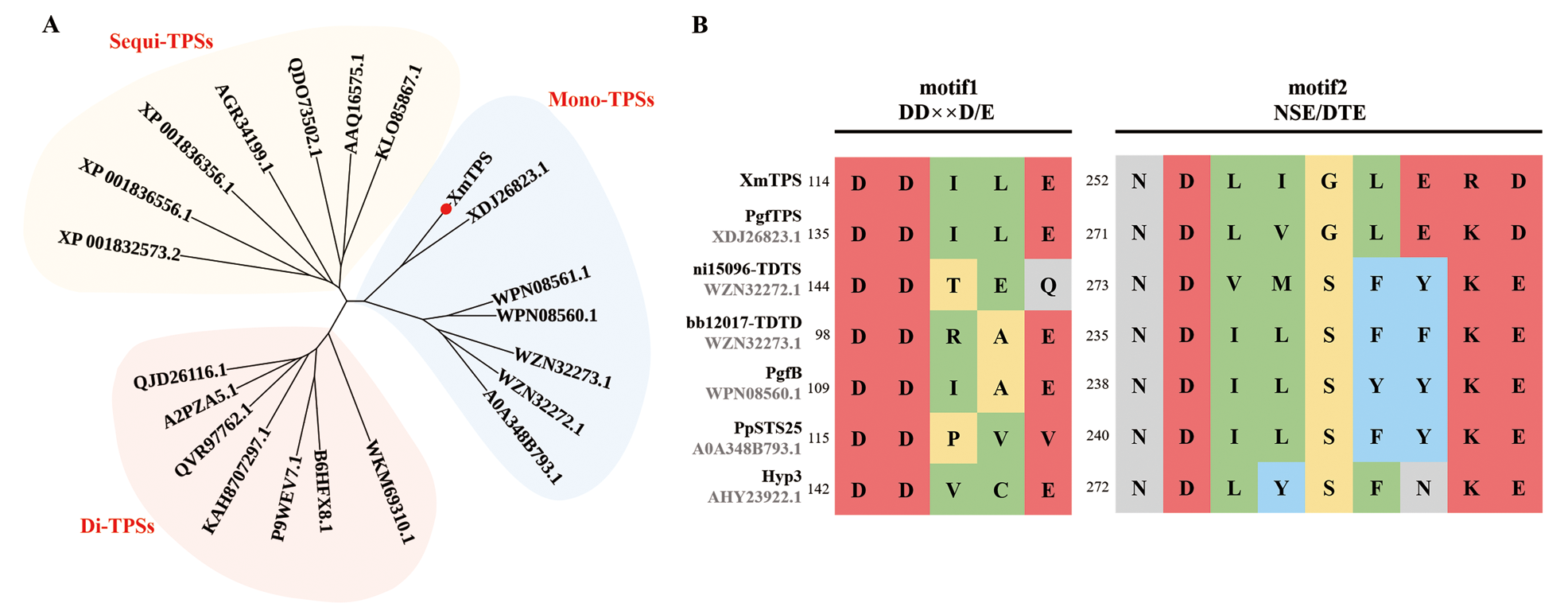
Fig.3 Analysis of phylogenetic tree and conserved domain of XmTPS protein A: Phylogenetic tree analysis of XmTPS and selected fungal terpene synthases. Mono-TPSs: Monoterpene synthases; Sequi-TPSs: Sesquiterpene synthases; Di-TPSs: Diterpene synthases B: Analysis of conserved domain of XmTPS with characterized fungal monoterpene synthases XDJ26823.1,WPN08560.1 and QDO73502.1 are come from Penicillium griseofulvum; WPN08561.1 is from Penicillium italicum; WZN32273.1 is from Beauveria sp.; WZN32272.1 is from Nigrospora sp.; A0A348B793.1 is from Postia placenta; XP001832573.2, XP001836556.1 and XP001836356.1 are all from Coprinus cinereus; AGR34199.1 is from Armillaria gallica; AAQ16575.1 is from Botrytis cinerea; KLO85867.1 is from Fusarium fujikuroi; QJD26116.1 is from Myrothecium gramineum; A2PZA5.1 is from Diaporthe amygdali; QVR97762.1 is from Aspergillus flavipes; KAH8707297.1 is from Beauveria bassiana; P9WEV7.1 is from Colletotrichum gloeosporioides; B6HFX8.1 is from Penicillium rubens Wisconsin 54-1255; WKM69310.1 is from Candolleomyces candolleanus; AHY23922.1 is from Hypoxylon sp.
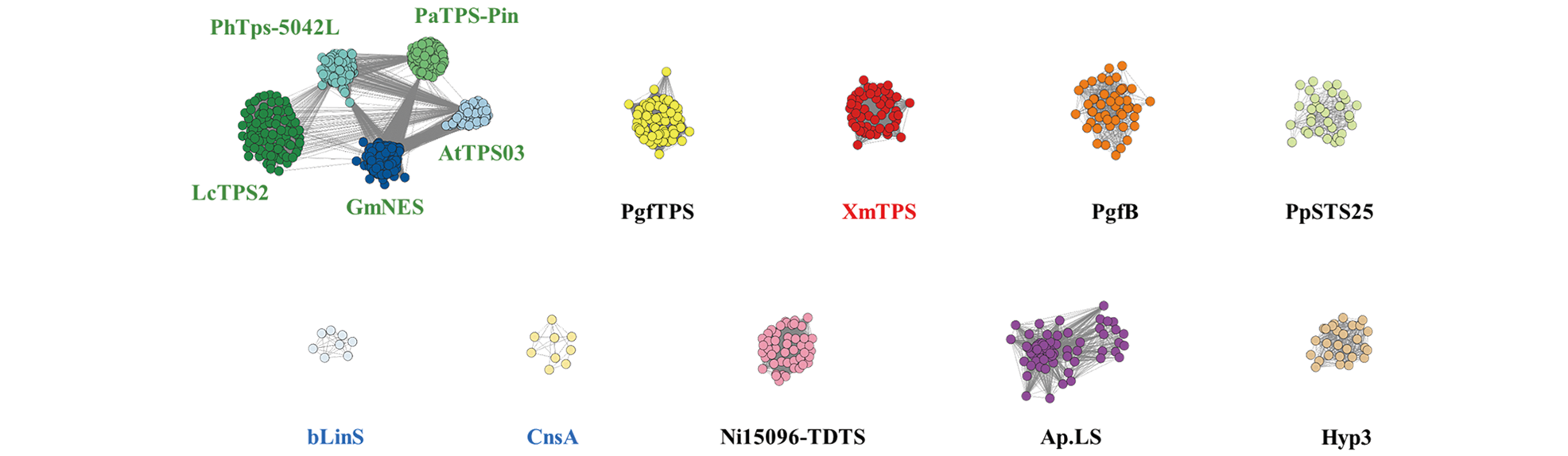
Fig.4 Sequence similarity network analysis of XmTPS protein The red branch represents XmTPS and its homologous proteins. AtTPS03, LcTPS2, PaTPS-Pin, PhTps-5042L and GmNES are plant monoterpene synthases (marked in green font). bLinS and CnsA are bacterial monoterpene synthases (marked in blue font). PgfTPS, PgfB, PpSTS25, Ni15096-TDTS, Ap.LS and Hyp3 are fungal monoterpene synthases (marked in black font)
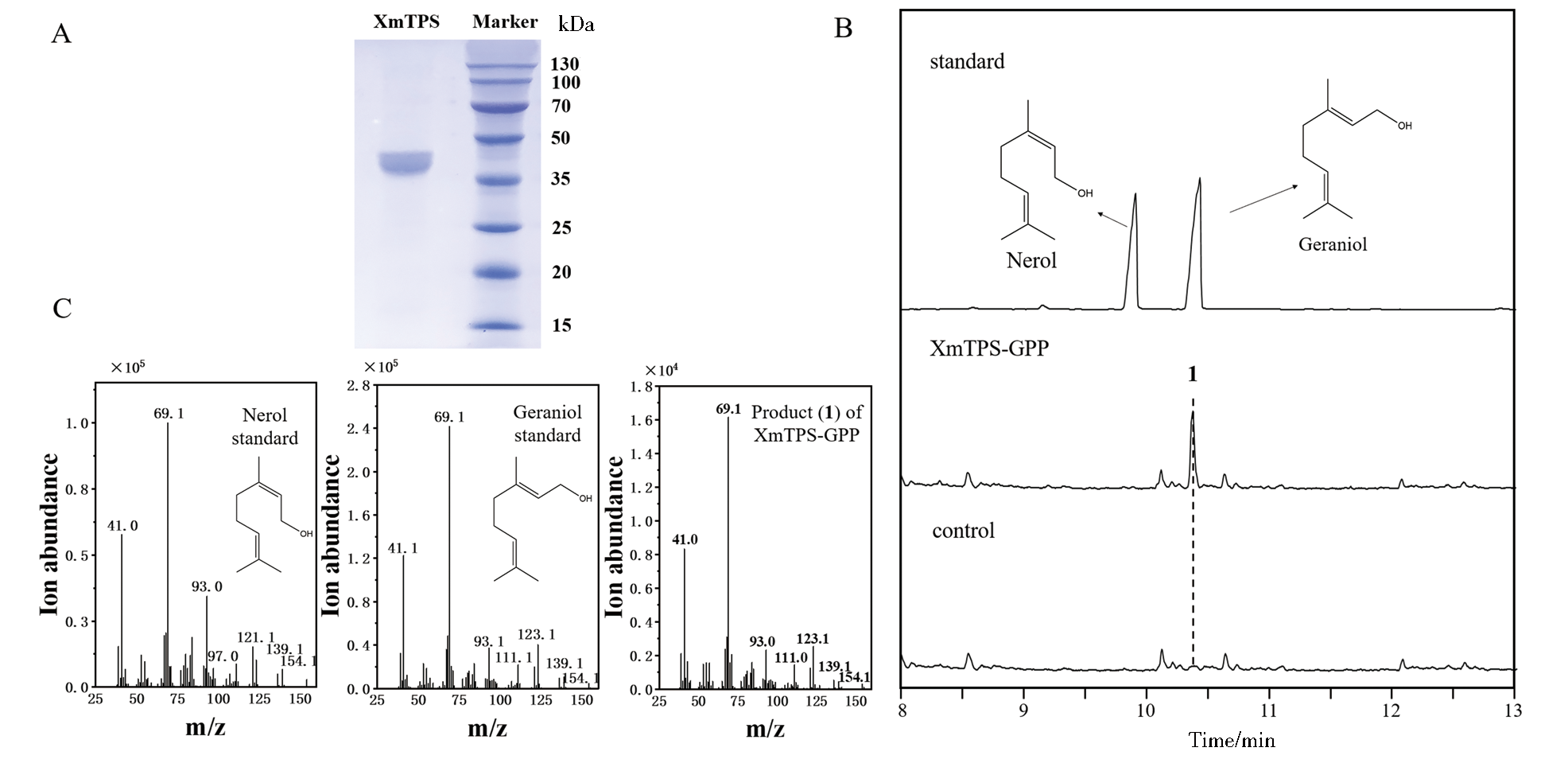
Fig.5 SDS-PAGE analysis of purified XmTPS protein and GC-MS detection of its in vitro enzymatic reaction products A: SDS-PAGE analysis of purified XmTPS protein B: GC-MS analysis of nerol and geraniol standards, as well as products catalyzed by XmTPS with GPP in vitro reaction C: Mass spectra of the enzymatic reaction product (1) and the reference substance nerol and geraniol
Fig.8 Comparison of amino acid sequences and protein structures between XmTPS and PgfTPS A: Amino acid sequence alignment of XmTPS and PgfTPS. Conserved metal ion-binding motifs are marked with boxes B: Protein structure alignment of XmTPS and PgfTPS C: Active site alignment of XmTPS and PgfTPS. Conserved amino acid residues shared between the two proteins are marked with red boxes; other amino acids represent conserved metal ion-binding motifs